
Sources for Reedley Previous Residents
One address can have an owner trail and a household trail that do not match. Fresno Recorder instruments establish grantor and grantee roles. The Assessor provides a current parcel and assessment lead. Haines Criss-Cross and Reedley telephone books can name listed occupants or subscribers. Census schedules describe households on the census date. Sanborn sheets explain the structure and street context. Obituaries, probate, yearbooks, and permits close particular gaps.
| Source | Local years | Where held | What it shows |
|---|---|---|---|
| Recorder searchable index | 1981 to present | Fresno Recorder Self-Service | Deed parties, dates, types, and documents |
| Scanned grantor and grantee books | 1856 to 1980 | Recorder books and counter | Earlier party chain and instrument citations |
| Haines Criss-Cross | 1973 onward | Heritage Center | Address-first listed occupants or subscribers |
| Reedley telephone and city books | 1933 to 1935, 1940, 1962 | Heritage Center | Local subscriber or household snapshots |
| Federal census | Through 1950 currently public | NARA and library tools | Household members, age, birthplace, occupation |
| Sanborn maps | 1891 to 1941 revision era | Heritage Center and selected scans | Building footprint and street continuity |
| Newspaper, obituary, probate | Dates vary | Library, court, Recorder | Life events, heirs, and property transitions |
The right source depends on the era. Begin with the APN for a legal property chain, the 1973 Haines run for a later address, the 1962 book for a direct Reedley snapshot, and the 1933 through 1940 telephone books for earlier local subscribers. The Genealogy and Local History Library is the deep access point.
The Fresno County Genealogy and Local History Library describes the collection where previous residents and house-history evidence can be compared.
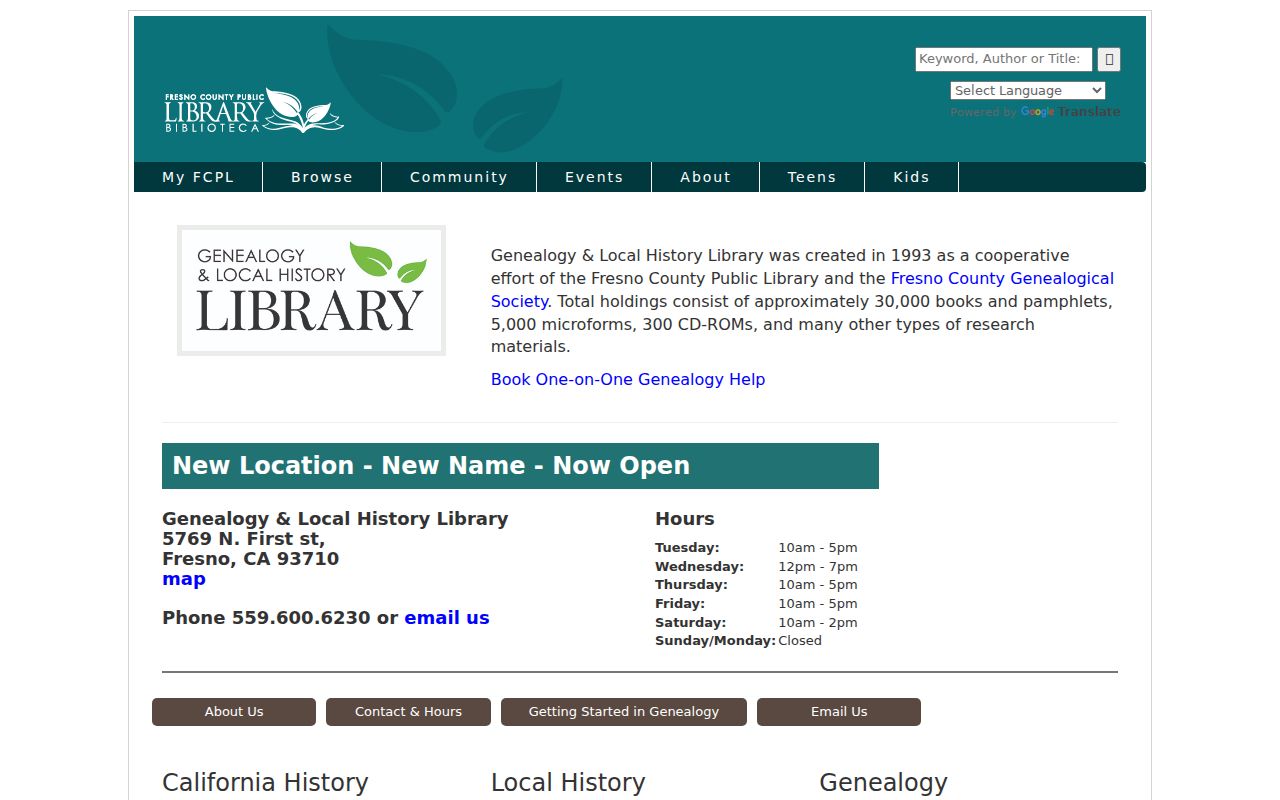
Library finding aids can point to the right directory, newspaper index, atlas, or microfilm run without pretending that one source covers every household.
Reedley Property Records and APN
Normalize the address through USPS, Reedley planning or parcel context, and the Fresno Assessor’s Situs Index. Record the APN, current situs, legal description, and municipal jurisdiction. The monthly ownership file can identify the January 1 assessee and a tax-mail address, but neither is proof that the owner lived there. The Assessor’s counter is at 2281 Tulare Street, Room 201, Fresno.
The annual Situs Index costs $29.21 and the monthly Current Ownership Name/Mailing Address file costs $30.94 in text or CSV and $54.94 in PDF. Fresno County will not sell a city-only subset, so a Reedley extract must be derived from the county product. If the web address-to-APN match is missing, that is the 2025 Government Code §7928.205 change, not evidence that the parcel has no history.
A current owner is the entry point to the deed chain. A current mailing address is only a contact lead. Keep those statements distinct in every previous residents note.
Reedley Records and the Deed Chain
The Fresno Recorder’s modern Self-Service index is searchable by grantor, grantee, recording date, document number, and document type. Search the current owner as grantee. Open the acquisition deed and record the grantor, date, instrument number, APN or legal description, book and page when shown, and any return-address evidence. Then search that grantor as a prior grantee and repeat.
- Confirm the parcel and legal description with the Assessor, situs product, GIS, or recorded map.
- Find the current owner’s acquisition as grantee in Recorder Self-Service.
- Record the seller as grantor, then search that seller as grantee in an earlier instrument.
- Repeat backward, preserving every date, document number, party role, and legal-description change.
- When the chain crosses 1981, switch from text search to the scanned year and name-letter books.
- Order a copy only after the citation is complete; free counter viewing can fill an earlier gap.
- Grantor
- The party conveying an interest in the recorded instrument.
- Grantee
- The party receiving an interest in that instrument.
- Chain of title
- A linked sequence of recorded transfers for the same parcel or legal description.
- Legal description
- Formal recorded land language that can bridge a changed street number.
Search the Fresno recorded-documents route for current instructions. A deed shows a recorded property relationship; it does not prove that the grantee occupied the address.
Reedley Records Since 1981
Online text coverage begins January 1, 1981. Earlier deeds are not automatically absent. The linked scanned index covers 1856 through 1980, with separate year and role browsing for 1856 through 1913, grantor and grantee books for 1914 through 1971, and combined books for 1972 through 1980. A pre-1981 copy order needs book, page, year, at least one party, and document type.
Fresno Recorder history reaches to 1856. State Archives microfilm includes Fresno deeds from 1875 through 1900 and probate from 1880 through 1920, overlapping rather than replacing county originals. When an old address does not appear in text search, keep the search date and coverage cutoff, then browse the correct book or ask the counter for a citation.
The California State Archives FAQ explains how archives and county historical materials fit into a previous residents search.
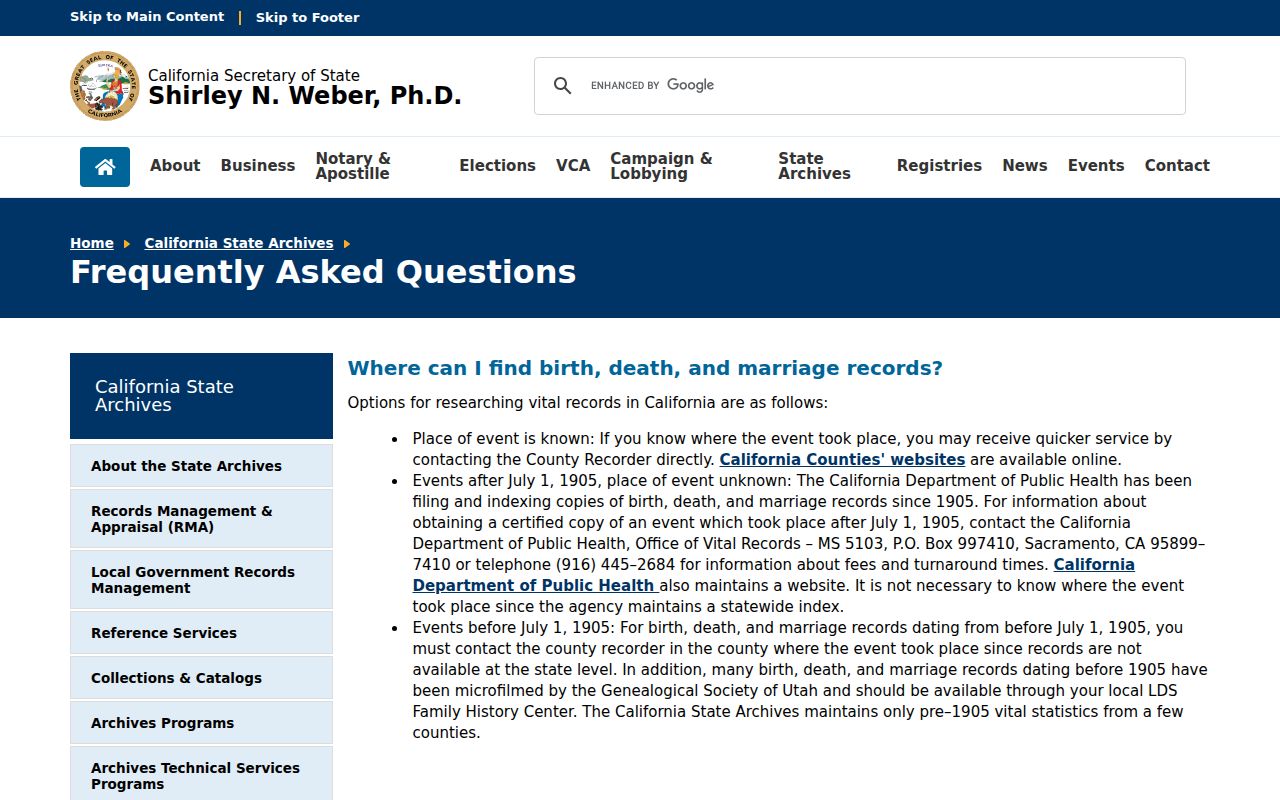
Use the record series and years as the search plan, not as a claim that an older book has disappeared.
Reedley Directory Telephone Snapshots
The four direct Reedley telephone books are 1933, 1934, 1935, and 1940. A Reedley city directory survives for 1962. Haines Criss-Cross returns from 1973. Countywide Polk volumes cover most years from 1907 to 1957, with gaps. These records provide dated listed subscribers or occupants, not a full household enumeration.
Use the exact street line, number, rural notation, locality, and phone number as the printed record gives them. The accessible telephone syntax can show person or business name, address notation, locality, and number; “r” or “Res” marks a residence. No accessible scan of the 1962 entry key was located, so inspect the volume’s abbreviations before explaining a symbol. The full collection history is in the Reedley city directory book.
Search the closest editions on both sides of the target year. A no-result can mean no telephone, rural-route addressing, an omitted subscriber, a name variant, or a missing volume. It cannot by itself erase a previous resident.
Reedley Street Records and Sanborns
Reedley Sanborn sheets document 1891, 1893, 1898, 1901, 1907, 1912, 1926, and the 1926 through April 1941 revision era. They can show a building footprint, use, street name or number, and physical change. They cannot name the people who lived there. Pair a sheet with a directory, deed, census schedule, newspaper, or permit.
The revised set can show pasted corrections and incremental change between nominal editions. That is valuable when a former address was renumbered or a structure changed use. Reedley’s street numbering began in 1916, so pre-1916 records may need intersections, businesses, lot descriptions, or neighboring structures as bridges.
Note: A map can prove that a structure was mapped; it cannot prove that a named person occupied it.
Reedley Residents in Historical Records
Previous residents are best reconstructed by pairing dates. A directory can give a street and subscriber clue. The census can show the household on its enumeration date. An obituary can connect a death to relatives and a place. Probate can name an heir or distribution. The Recorder can show a later deed or affidavit. The Cemetery District may answer a plot or interment question, though no online burial-name index was located.
- Set the address and structure with the deed, Sanborn sheet, or legal description.
- Read Haines from 1973, then the 1962, 1940, 1935, 1934, or 1933 local books as the era requires.
- Pair the directory with the nearest released census schedule and note household differences.
- Search the Fresno Bee and obituary indexes from 1922 onward, plus the Fresno Genealogical Society card index from 1962.
- Use probate, cemetery, and later deeds to explain a death, heir transfer, or departure.
The Fresno County Library census and Great Registers guide identifies the released census and substitute register material used with previous residents research.
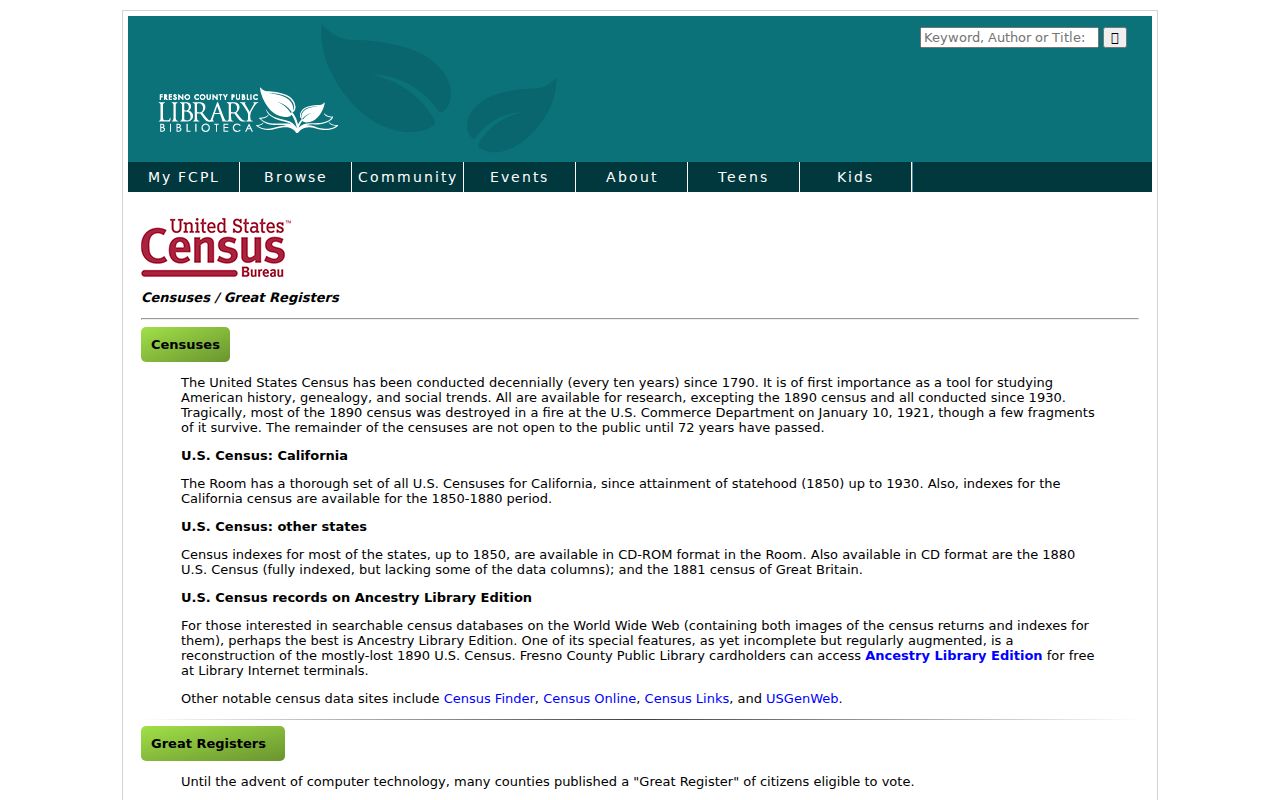
A register describes eligible voters, not the whole Reedley population. Pair it with directories, deeds, newspapers, or atlases.
The Fresno County Library birth, marriage, and death holdings provide finding aids for event dates that can close a previous residents trail.
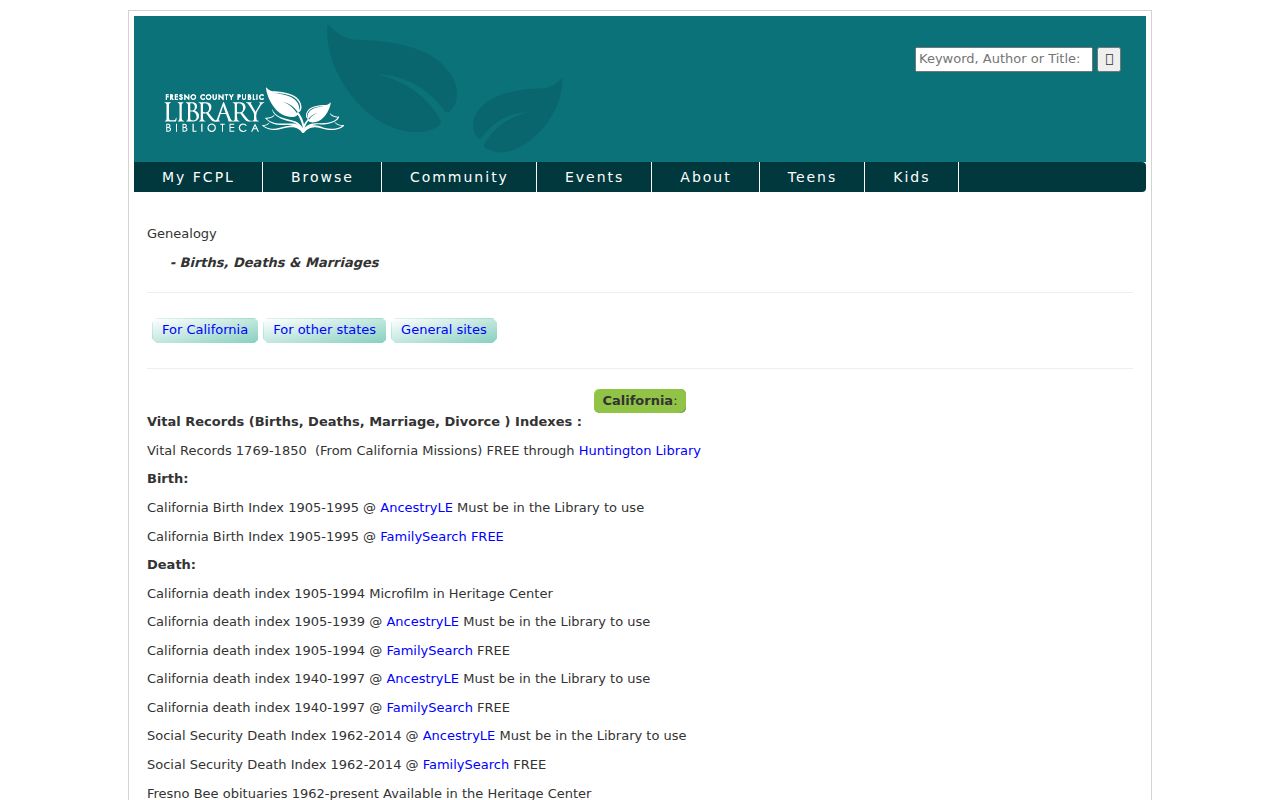
Use an index to find the likely record, then follow Fresno County or CDPH eligibility and copy rules.
The Fresno historical indexes describe newspaper and obituary finding aids that can close a previous residents trail.
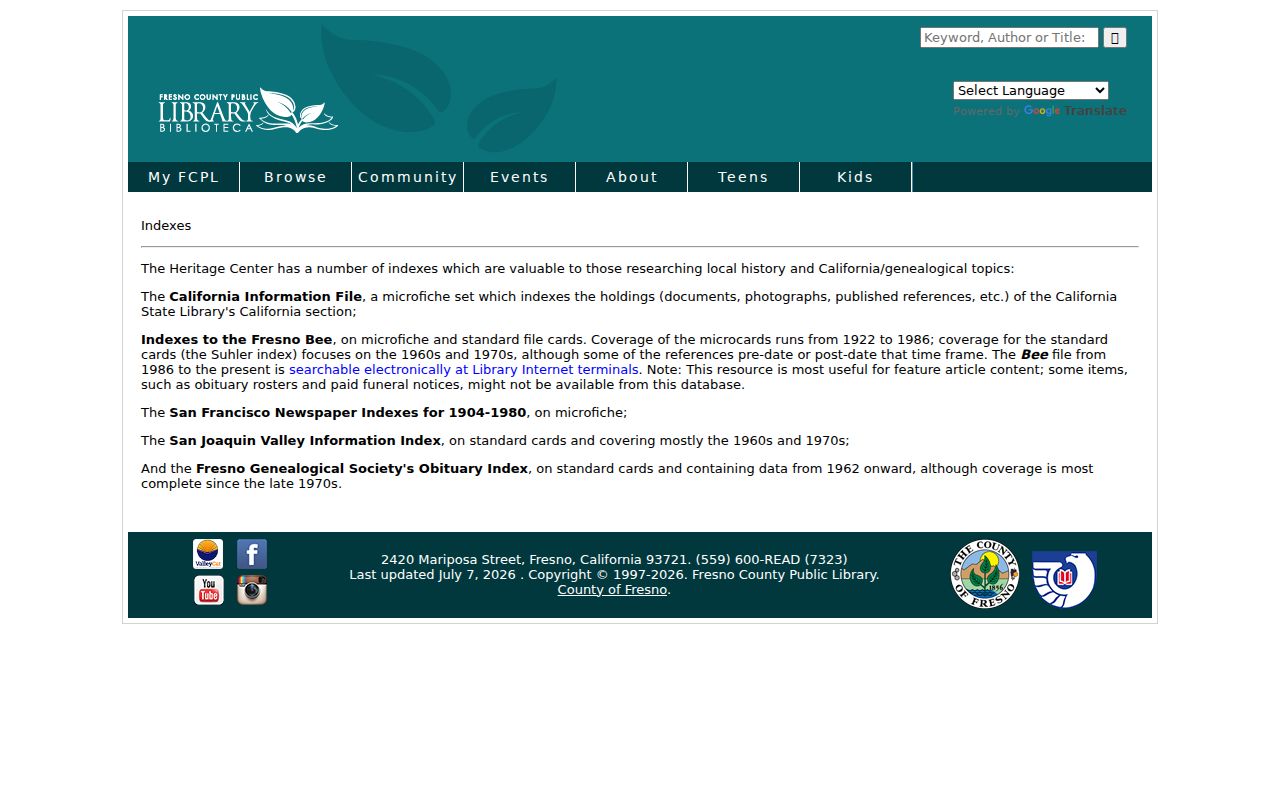
An index miss is not proof that no notice exists; feature and paid notices may be omitted.
Reedley Address Records and Permits
Reedley has no identified public permit or code-case search. Ask Community Development or the City Clerk for an existing file with the address, APN, project name, permit type, and date range. Records can include a building permit, inspection history, zoning application, conditional-use case, CEQA document, code file, contractor, or project contact.
Permit evidence can date an alteration or explain a changed structure. It does not establish who lived there. The local FOG program, for example, associates a new food-service business with a sewer-connection application, an $80 fee, plumbing schematic, and grease-maintenance documents. Keep the named role as applicant, owner, contractor, or contact.
Close a Reedley House Record
A house history often ends with an obituary, probate filing, cemetery inquiry, or later deed rather than a single perfect resident list. The Reedley Historical Society at 1752 10th Street, PO Box 877, Reedley, 559-638-1913, may hold photographs, family files, organization material, funeral or cemetery information, and address history. Confirm access before travel. The Heritage Center’s vertical file and local books can supply names to test in county records.
Record the custodian, search date, exact query, coverage cutoff, result identifier, and copy type. Mark deductions clearly: a mailing address differs from situs; a same surname is not a family link; an old directory line is not continuous occupancy. The best previous residents account is transparent about what the sources show and what remains unknown.
Lawful house history. Use past-resident research for family history, preservation, genealogy, and personal curiosity. Do not use an address trail to stalk, harass, intimidate, or harm any living person.
Note: A carefully bounded gap is more useful than a guessed household member or an unsupported current address.